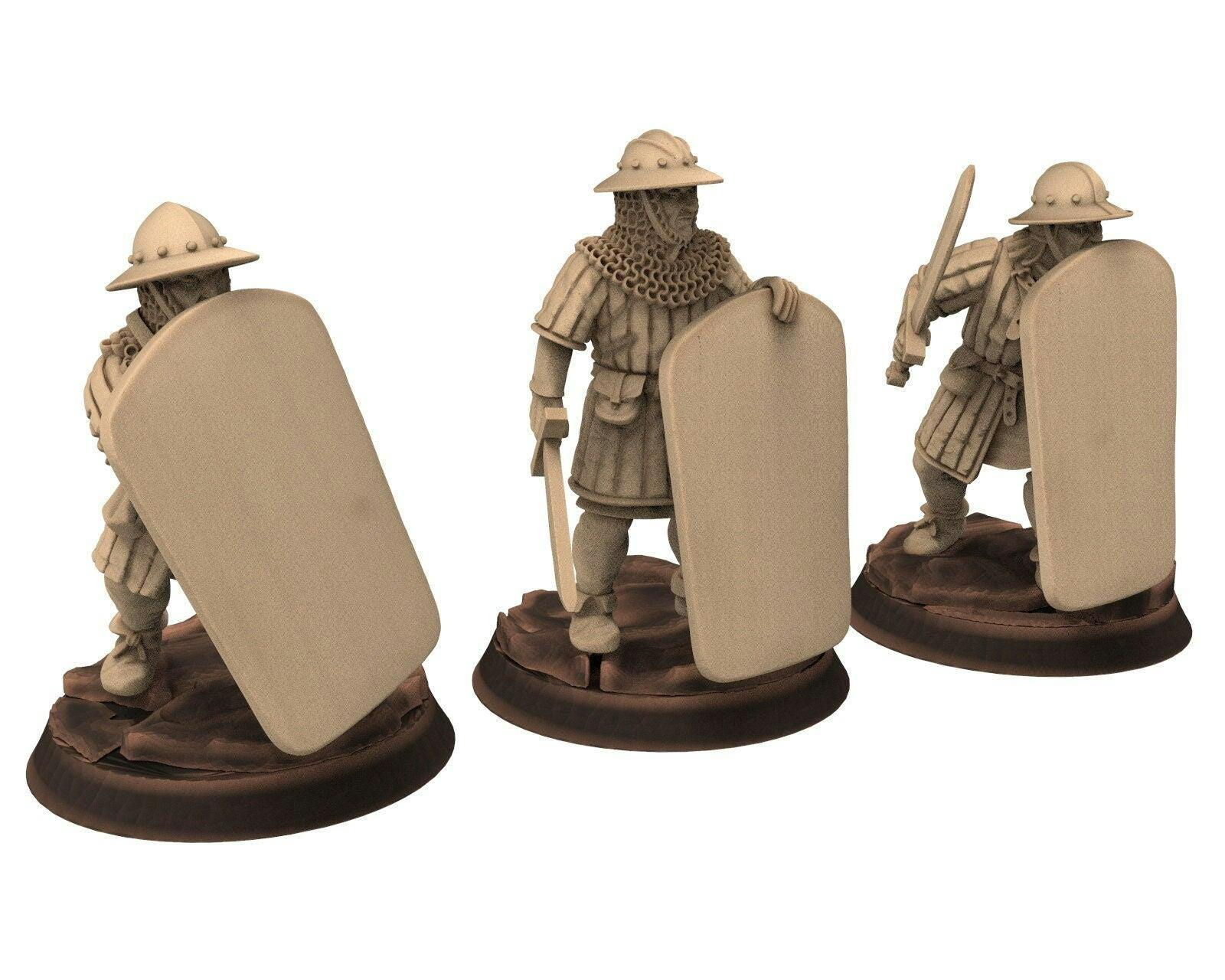
- Some models are single-piece; others may require simple assembly.
- Printed in solid, non-hollowed, ABS-like resin.
- Most supports have been removed.
- Bases are not included.
- Supplied unpainted.
- Not suitable for children under 6 years of age.
- Any warped parts can usually be straightened with hot water, although this is rarely necessary.
- Assembly can be done easily in a few seconds using a small amount of white (wood) glue on one part and strong superglue on the other.
28mm scale (for Saga, Lotr, D&D Frostgrave).
These models were made by Medbury miniatures and are sold under license.
https://www.patreon.com/medburyminiatures/posts
During the Middle Ages, the crossbow, also known as the arbalest, became a popular weapon among European armies. The crossbow was a powerful weapon capable of penetrating armor at a distance, and it was effective in siege warfare.
One of the reasons for its popularity was that the crossbow was relatively easy to use, and it didn't require the strength and training needed for a longbow. Crossbows were often used by both infantry and cavalry, and they were effective against both mounted and foot soldiers.
The crossbow also had a longer range than the longbow, allowing soldiers to attack from a distance, and its accuracy was superior to that of other missile weapons of the time.
However, the crossbow had some drawbacks. It was slower to reload than a longbow, and it was also heavier and more cumbersome to carry. In addition, it required a specialized bolt, which was expensive to make.
Despite these drawbacks, the crossbow remained popular throughout the Middle Ages and was used in many important battles, including the Battle of Agincourt and the Battle of Crecy.
In the 14th and 15th centuries, new designs for the crossbow emerged, including the arbalest, which was larger and more powerful than earlier models. The arbalest had a longer range and could penetrate armor more effectively, making it a formidable weapon on the battlefield.
Overall, the crossbow played an important role in medieval warfare, and its popularity endured for centuries, even as new weapons were developed.